
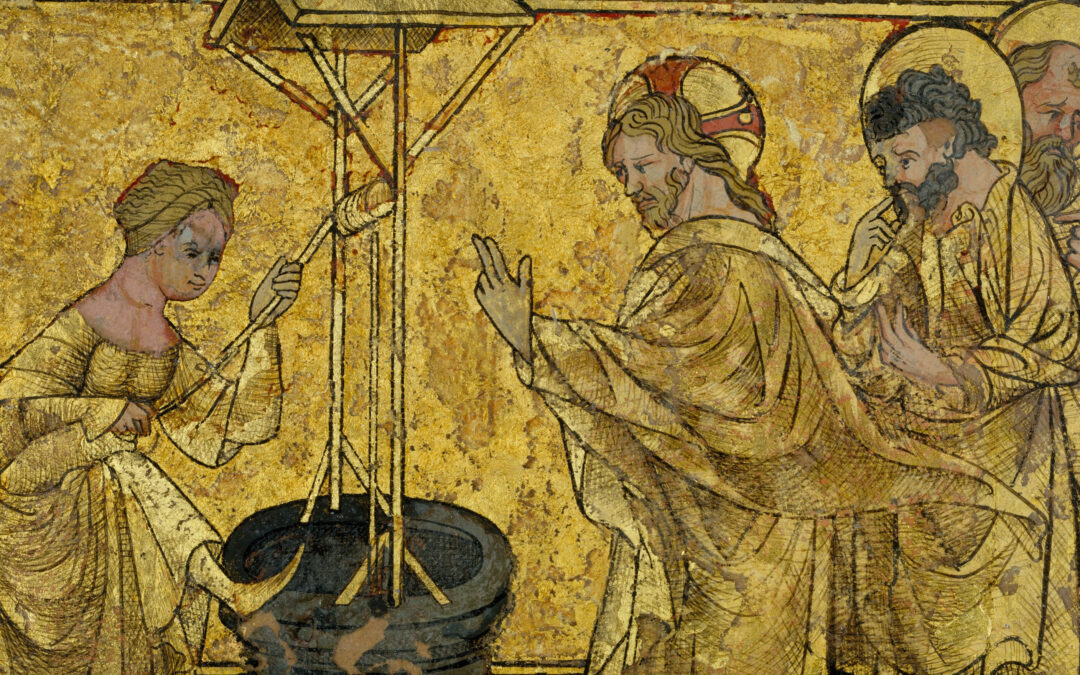
Gospel: John 4:5-24
I would like to take you back three weeks ago to Feb 20th and 21st and the 42nd Annual Convention of the Diocese of East Tennessee. The theme of the Convention was “Equip Disciples”. So the question I have for you is this: what does it look like when we talk about “equipping disciples” – not just at the diocesan or parish levels but at the very personal level. We are all called if not guided by the Holy Spirit into ministries where we are encouraged to take Jesus’ “Good News” to others.
As we embark on this journey, sometimes alone but ofttimes with each other, these questions often arise: what exactly is it God intends of me? Or have I strayed from the path the Holy Spirit is guiding me into? And what if I continue to have questions and doubts about my path or faith?
As we seek to discern the answers to these questions, the anxiety and fear that are a part of the secular world in which we live have become powerful and sometimes overwhelming distractions. The ground seems to continually shift under our feet – making it difficult either discern or to stay on the path the Spirit has called us to.
Yet sometimes it is not until we pause in our journey and take a long, loving look back at where and how far we’ve come that we are able to discern the Spirit’s loving guidance – despite, as Mtr Mandy described in her sermon last Sunday, bumps in the road or those self-determined detours we took – convincing ourselves we are on the path God wanted for us. Only to discover that our path is not the one the Spirit intended.
I can almost hear the Spirit saying, “this is not what I had in mind for you. But, hey! Knock yourself out. I’ll be here waiting when you come back!”
So, in returning to Convention’s theme and the question “what does equipping disciples look like”, I think the Gospel reading from John’s story of the “Woman at the Well” offers us some insights as we discern our path into discipleship.
It’s all too tempting to become lost in the historicity of the times, as well as
the prevailing social and cultural norms in the ancient world of Palestine. But to do so diminishes the full power and impact of Jesus’s encounter and engagement with the Woman and her with him.
What emerges, though, in John’s story is the picture of a broken, flawed woman – alone, alienated and ostracized from her community; and yet a woman of amazing strength and courage as she made a fundamental and life-altering choice to engage and “be with” Jesus. She did not turn away or flee to the village with her water jar, but she stayed and made the decision to hear about the new water available to her: New Water that quenches the soul; and about the Good News of a new life – one not based on previous faults, sins or transgressions.
The woman said to him, “I know that the Messiah is coming. “When he comes, he will proclaim all things to us.” Jesus said to her, “I am he, the one who is speaking to you.”
And then the woman does a most astonishing and extraordinary thing! She leaves her water jar at the well and returns to her village – to the people who had denounced her, accused her of being a woman of uncertain virtue, and had condemned her as a pariah in her own community!
Despite this, “She said to the people, “Come and see…..!”
“Come and see…!” An invitation to come and see and be with the man who through his engagement with her and her with him, had changed her life. She no longer had need of her water jar, perhaps a symbol of her former life, to quench her thirst, but she now had “Living Water” to quench and nourish her soul. She was, in a sense, on a path towards transformation, not yet complete as she questioned: “He cannot be the Messiah, can he?” Yet her transformation was not a “one and done” affair, but rather, as it is with most of us, a life-long journey often accompanied by many questions if not doubts.
The Woman at the Well is widely regarded as the first evangelist in that she brought the “the Good News” she had encountered in her engagement with Jesus back to share with her people.
There is so much here to draw on as we circle back, and ponder the answers to the question: equipping disciples.
It begins, as it did with the Woman, as a willingness to enter into that sacred space with Jesus – for her a face-to face encounter with him, and for us that sacred space we enter into in prayer.
It begins with recognizing that the Woman at the Well is us! And just as Jesus did not shy away from the Woman whose transgressions had become so much a part of who she was, neither does he shy away from us as we bring our own brokenness to Him.
It begins, as it did with the Woman, as we share the Good News with others and when we invite them to “come and see!”
It begins as we recognize that we do not travel alone.
It begins through prayerful discernment as we begin to truly recognize the Spirit’s transformative path for us into discipleship or into lay ministry where we are called to serve.
Robert Frost in his poem, “The Road Not Taken”, writes:
‘I shall be telling this with a sigh
Somewhere ages and ages hence:
Two roads diverged in a wood, and I –
I took the one less traveled by,
And that has made all the difference.’
For us, that “road less traveled may very well be that transformative path the Holy Spirit is calling us into, and a journey that leads us into discipleship and ministry.
And finally, there may come a moment on our path, guided by the Holy Spirit, when we are able to discern that “spark”; that “something” that guides us to look outside and beyond ourselves; that “something” that works on our heart; that “something” when we might feel compelled to share ourselves with others – not out of a sense of obligation, but rather out care and love for the “other”.
As we journey together on “the road less travelled” – that path the Holy Spirit has set us on into discipleship or ministry, we then might be able to say, just as the Woman at the Well, “come and see!”