

His words across the miles reverberated across the stagnant waters of the muddy Chattahoochee and soothed my weary soul. I had slipped away from the noise of the conference when I saw the notification pop up on my phone: a voice message from Vincent Pizzuto. A scholar of the New Testament and Christian mysticism, I value Vincent’s theological wisdom and his ability to articulate the depths of the Christian contemplative tradition. But that day, I needed to hear from him not as a scholar, but as my anam cara, a dear soul friend who knows something of the weight of ministry because he has carried it himself.
I hiked down the trail through the muggy summer heat, listening to his response to the message I had sent telling him about the overwhelm I felt in the first few weeks of my first call as a priest in a local parish. The pressure above my breastbone and the knot in my shoulders were a constant reminder of the anxiety that stalked me through the days. A priest for twenty years already, I knew he would understand what I felt in a way others could not.
“This is the yoke of the priesthood,” I heard his voice say across the miles. “One side of it is full of such joy, but the other side is the weight. People don’t see that.”
He proceeded to invite me to think of what I saw as this thorn in my side as a place I could invite others into who think I am so competent and “together” as a priest. “When you open up those interior places of your sense of anxiety to other people, you will become not only healing for people who you open up to, but you’ll find community for yourself.”
A few days later, I did just that. Sitting with my spiritual director, tears freely coming, we spoke about this “yoke” I felt: the weight of carrying other people’s needs and my own crushing expectations of myself. I told her about the prayer I pray before putting on my priest’s stole each Sunday: “Make me, O Lord, thine other self in the world, that I may bear the yoke of thy priesthood with humility and grace.”(1) She closed her eyes and tilted her head to the side as though listening for a voice.
“Hmm,” she pondered. “You noted that you feel the anxiety in your shoulders, the very place the stole sits on your body. Perhaps as you begin your day, you could remember this prayer and this action of putting on this stole. Remember how it feels in your body, to wear this symbol of the weight and privilege of service to God.”
I left that conversation thinking about the stole differently. Until then, I had thought of the yoke primarily as a metaphor. My spiritual director returned me to my body. The place where I carried my anxiety was also the place where I carried this visible sign of priestly vocation. The theology was no longer abstract. I could feel it.
The following week, I listened to a sermon by Vincent, the same priest whose voice had accompanied me along the Chattahoochee trail. What he said stopped me in my tracks. He was speaking about Christian mysticism as a “gritty mysticism,” one that is “spiritual precisely because it is material.”(2) Rather than imagining mysticism as an ascent away from the world, he described a God who has descended to meet us here.(3) He spoke of the mystical life not as escape from the material world but as an encounter with God within it.
I have spent years thinking and writing about contemplation as an embodied practice, so none of this was a new theological idea for me. And yet, hearing Vincent speak about it in that moment brought something into focus. Only days earlier, my spiritual director had helped me notice the physical weight of the stole on my shoulders. Now, Vincent’s words gave me a theological lens through which to see that experience differently. This is why the stole made sense to me in a whole new way.
What I had experienced in the conversation with my spiritual director was not merely a useful psychological technique for managing anxiety. It was an embodied theological practice. The weight on my shoulders could become a reminder of the way God meets us, not by asking us to transcend our humanity, but by entering it.
This is, after all, the scandal and mystery of the Incarnation. God did not save us by remaining above the material world. The Word became flesh. God entered a body capable of hunger, exhaustion, grief, pain, touch, and death. Christianity does not give us a God who asks us to escape the body to find holiness. It gives us Christ.
Vincent’s sermon helped me see that this makes Christian contemplation inherently embodied. He described it as a “mysticism of descent”: we need not strive toward some heavenly height in order to encounter God, because in Christ, God has already descended to us.
That descent changes what we mean by contemplation.
There is a tendency to imagine contemplative spirituality as movement away from the body and the world: upward, toward some purer spiritual reality where the noise and messiness of ordinary life fall away. Mystical experience can easily become associated with transcendence, extraordinary states of prayer, or escape from the ordinary self.
But Christian contemplation cannot finally be an escape from embodiment because Christianity itself refuses that escape. The center of our faith is not an idea or an ethereal consciousness. It is a body, and bodies are gritty. Bodies grow tired. They ache. They carry tension. They become sick and healed, strong and weak. They experience desire, grief, pleasure, fear, exhaustion, and joy. They bear the marks of our lives. The contemplative life, therefore, cannot be separated from these ordinary physical realities.
Perhaps this is why Paul’s “thorn in the flesh” has become so compelling to me. Paul does not tell us precisely what his thorn was. Whatever it was, he pleaded with God repeatedly that it might be removed. His prayer was not answered in the way he wanted. Instead, he heard: “My grace is sufficient for you, for power is made perfect in weakness.” Paul’s mystical life did not lift him permanently out of his embodied struggle. He encountered grace in the midst of it.
This is important because we can subtly imagine spiritual maturity as becoming increasingly free from the things that trouble us. We might measure contemplative growth by how peaceful we feel, how disciplined our prayer has become, or how little we are disturbed by circumstances around us. I needed to be reminded that Paul’s experience suggests another possibility. Perhaps spiritual transformation is not demonstrated by the absence of thorns, but by what happens to us in their presence. The thorn becomes a place of encounter.
This does not mean romanticizing suffering or pretending that every wound is secretly a gift. It means recognizing that God’s transforming work does not require us to become people without weaknesses before we can become instruments of grace. In fact, our weaknesses may become places through which we discover both our need for one another and the wideness of God’s mercy.
This is where the grittiness of contemplation becomes communal. In this sermon, Vincent speaks of the fruits of Christian mysticism not primarily in terms of private spiritual ecstasy but in “compassionate service to others.” The measure of our encounter with Christ is not simply what we experience in prayer but what kind of people we become because of it.
That shifts the emphasis of our contemplative practice. The question is not whether my prayer is filled with spiritual insight, or whether I can achieve some particular state of stillness. The deeper question is whether I am becoming more capable of love. Can I remain present to another person’s suffering without needing to fix it? Can I acknowledge my own limitations? Can I receive another person’s vulnerability without judgment? Can I allow my own weakness to make room for genuine community?
In this sense, contemplation is not private spiritual achievement. It is formation for participation in the life of Christ. Vincent put it another way: “We ascend by descending.” We look inward, not so that we can remain preoccupied with ourselves, but so that Christ in us may move outward.
That is precisely what happened on that muddy trail, and again in my spiritual director’s office. I began with my own anxiety, my own sense of inadequacy, my own thorn. But both conversations moved me beyond myself. My friend invited me to open my weakness to others. My director invited me to feel the weight of the stole in my body. The sermon invited me to understand that movement theologically: God meets us in the places where we are most human and then sends us outward in compassionate service.
The contemplative life, then, is not a retreat from the world but a deeper consent to it. We descend into ourselves and discover Christ already there. We attend to our bodies and
discover that they, too, can become places of prayer. We acknowledge our thorns and discover that grace does not wait for us on the other side of our weaknesses. Grace is already there.
The stole still has weight. My shoulders still tighten. The yoke still carries both joy and burden. But now, when I put it on and pray, “Make me, O Lord, thine other self in the world,” I hear the prayer differently. I am not asking to become someone untouched by the weight of priesthood. I am asking to become available to Christ within it.
Perhaps that is the grittiness of contemplation: not escaping the weight but learning how to bear it differently. Our life in Christ is not about transcending our humanity but allowing God to inhabit it so completely that our very humanity becomes a vessel for divine love.
The call to God and the call to the world are not two movements. They are one. We look inward so that Christ in us may move outward. We ascend by descending.
- Vincent Pizzuto, “Prayer for Vesting,” unpublished prayer, provided to the author.
- Vincent Pizzuto, “Mysticism of Decent,” St. Columba’s Episcopal Church Sermons, July 3, 2021, Apple Podcasts, 15 min. cf. Vincent Pizzuto, Contemplating Christ: The Gospels and the Interior Life (Liturgical Press, 2018), 11-13.
- cf. Pizzuto, 37-38; 115ff.
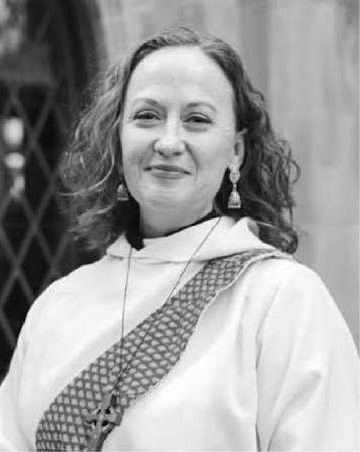
Nicole T. Walters is an Episcopal priest in the Diocese of Atlanta, writer, and contemplative theologian. She has spent more than twenty years serving churches and nonprofits in the United States, the Middle East, and South Asia. She holds a Doctor of Ministry focused on contemplative congregational formation and an MA from Winebrenner Theology Seminary, as well as a Master of Theology from Candler School of Theology at Emory University. Her work explores contemplative practice, spiritual formation, and what happens when faith becomes a way of being present to God, to others, and to the world. Her scholarship has been featured by Contemplative Outreach, and her writing has appeared places like Christianity Today, (In)Courage, and The Message Women’s Devotional Bible. You can find her online at nicoletwalters.com.